My Day Job holds two competing truths at the same time.
1. I am profoundly aware that I am very fortunate to hold a career position that benefits others in tangible ways I can measure. It also supports my family, various worthwhile causes, and gives me opportunities to pursue hobbies in my free time.
2. I still feel anxiety from time-to-time during many incoming commutes, and sometimes get a head start with Sunday Scaries. Some days in the office are wins, some are grinders, some not so great.
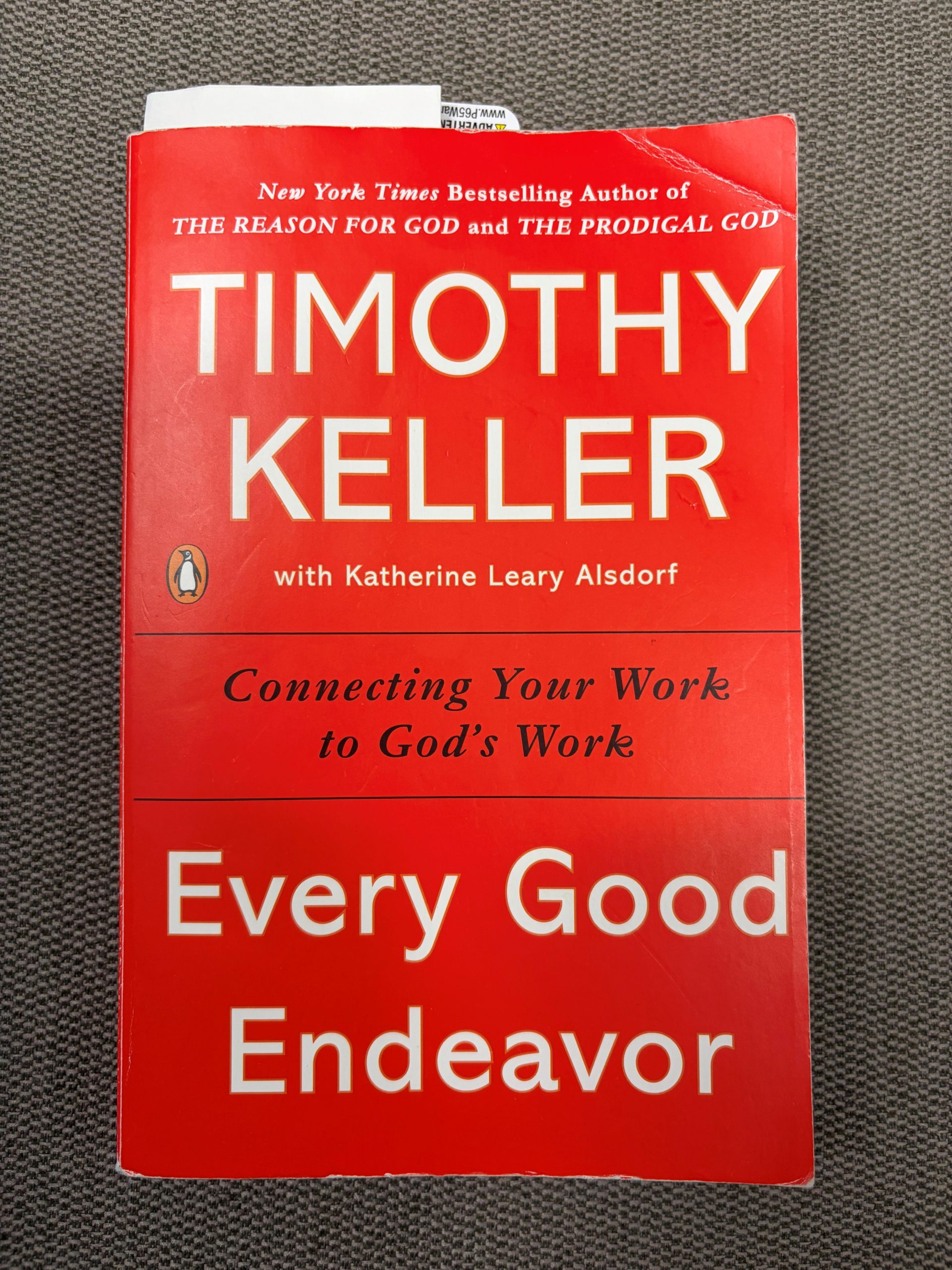
Every Good Endeavor by Timothy Keller with Katherine Leary Alsdorf reminded me that both truths are true.
The businessperson’s breakfast I’m occasionally part of went through this book (this isn’t a sponsored post or anything like that)
Thoughts on how I am very fortunate, I’ve been holding my current position for almost 10 years. I’ve been working professionally since I graduated from University in 1988, doing worthwhile work for real people, receiving promotions and opportunities along the way.
Work is a gift and stewardship from God, Every Good Endeavor details it this way:
Recovering Vocation is important
(From the introduction) – “…work as a contribution to the good of all and not merely as a means to one’s own advancement…”(p2).
Work is the design of God
“God made the world…as an artist makes a masterpiece.” (p20).
Work has dignity
“Work has dignity because it is something that God does and because we do it in God’s place, as his representatives.” (p36).
Work is cultivation
“It is rearranging the raw material of God’s creation in such a way that it helps the world in general, and people in particular, thrive and flourish” (p47).
Work is service
“…(God) equips all people with talents and gifts for various kinds of work, for the purpose of building up the human community.” (p55)
Do you have a robust understanding of God’s work and our calling / privilege to join in that work?
Even with this awareness, what is the problem?
In short, the curse of a broken world. The world is broken, not the way it is supposed to be, not the way we wish it to be.
Every Good Endeavor acknowledges as such:
Work becomes fruitless
“We were designed to know, serve, and love God supremely – and when we are faithful to that design, we flourish. But when we instead chose to live for ourselves, everything began to work backward.” (p77)
Work becomes pointless
“Nothing within this world is sufficient basis for a meaningful life here.” (p93)
Work becomes selfish
“…self-centeredness and competitive pride are at work deep in each of us.” (p113).
Work reveals our idols
“Martin Luther…defined idolatry as looking to some created thing to give you what only God can give you” (p128),
Do you feel the brokenness?
What Every Good Endeavor reminded me (I already know these to be true)

I know that work is valuable to me, my employer, my clients, and my world of influence, and I’m sure you know your work is valuable to you too. Endeavor helped me put categorize and specify my general thoughts into specific ideas:
“The gospel is the true story that God made a good world that was marred by sin and evil, but through Jesus Christ he redeemed it at infinite cost to himself, so that someday he will return to renew all creation; end all suffering and death; and restore absolute peace, justice, and joy in the world forever.” (p162).
“The gospel-centered business would have a discernable vision for serving the customer in some unique way, a lack of adversarial relationships and exploitation, and extremely strong emphasis on excellence and product quality, and an ethical environment that goes “all the way down” to the bottom of the organizational chart and to the realities of daily behavior, even when high ethics mean a loss of margin. In the business animated by the gospel worldview, profit is simply one of many important bottom lines.” (p167).
“Corporate profits and influence, stewarded wisely, are a healthy means to a good end. They are vital to creating new products to serve customers, giving an adequate return to investors for the use of their money, and paying employees well for their work. Similarly, individual compensation is an appropriate reward for one’s contributions and is necessary to provide for oneself and one’s family. But it is not our identity, our salvation, or even our source of security and comfort. The Christian worker or business leader who has experienced God’s grace is free to honor God, love neighbors, and serve the common good through work” (p165),
Endeavor continues with application ideas for various vocations (business, journalism, arts, etc).
What I’m striving to do about it:
1. Sharpen my focus on my career as a gift from God to be stewarded wisely for his glory, others’ benefit, and my maturity.
Give thanks for the gifts he has given me!
2. Sharpen my mindfulness that God provides for my family’s and my needs by providing health and skills in which to make a living.
Give thanks for his provision!
3. Sharpen my servant leadership awareness that God provides for my employer’s, co-workers’, clients’ needs by giving them my contributions to the common good.
Give thanks God chooses me to make an impact for the good of others!
4. Thankful to be part of a free market economy. Capitalism is not perfect, no other economic system can possibly be perfect on this side of the new heaven and new earth. An economic system’s design is not the problem, the people in it are, so I am an ambassador not only for the gospel but also for God’s provision of freedom.
Romans 3:23, “For all have sinned and fall short of the glory of God, and are justified by his grace as a gift, through the redemption that is in Christ Jesus…”
5. Regarding this writing project I’ve recently undertaken (thank you for reading, by the way!), I will do my best to produce good content that will hopefully be of benefit to others, share it, and see what God’s providence does with it.
What about you? How are you doing at this stage in your career? What is going well? What are you still striving to improve?